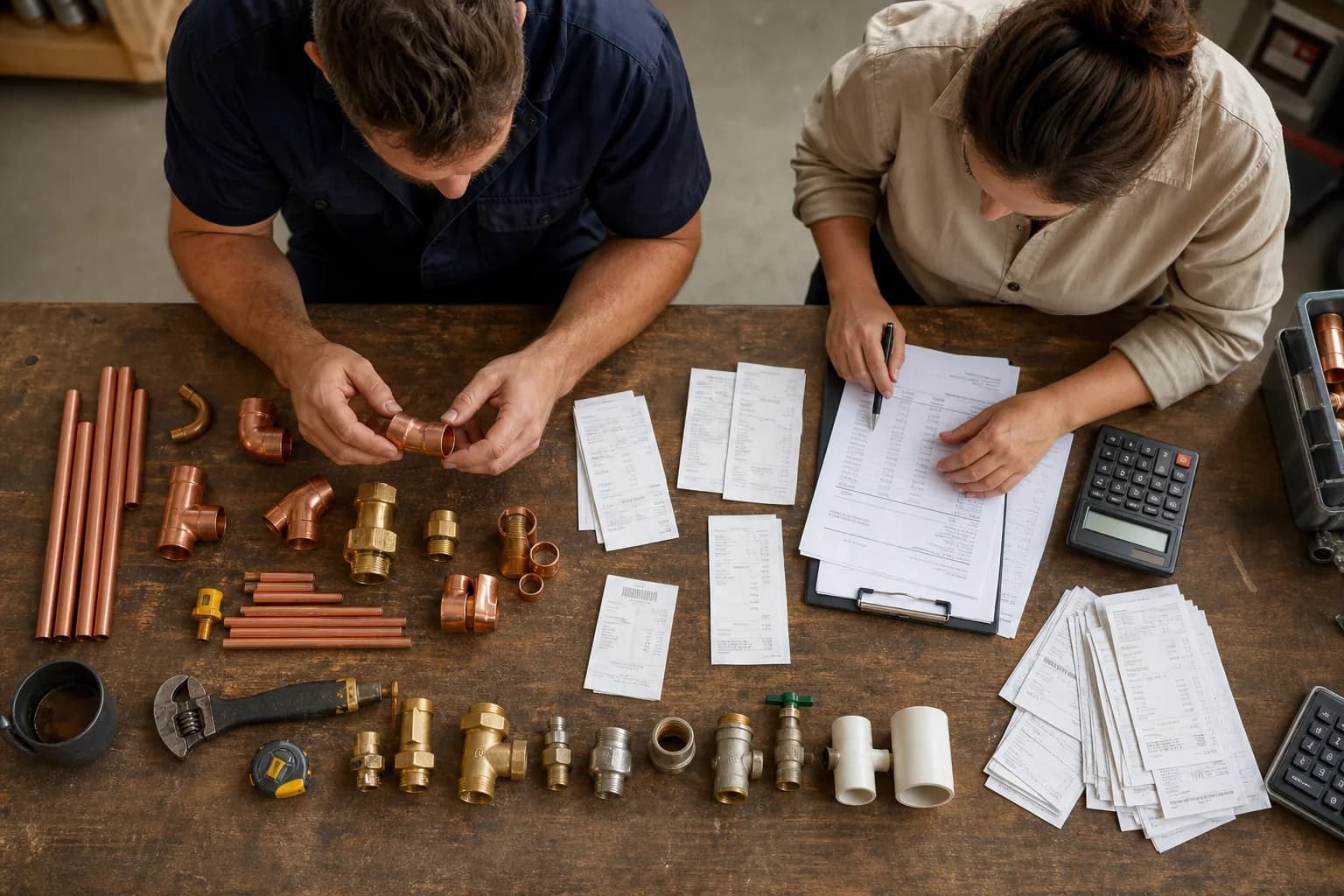
Many construction contracts are not pure labour. They combine the supply of materials with the work of installing them, and that mix is where the Construction Industry Scheme becomes fiddly. The deduction does not apply to the whole payment: it applies to the labour element only, with the materials element stripped out. This article explains how to evidence that split and where HMRC challenges it.
Mixed-contract treatment affects several other CIS calculations. The labour figure produced by the split feeds a subcontractor's turnover for Gross Payment Status testing and forms part of the construction spend used to assess deemed-contractor status. Get the split wrong and several other calculations move with it.
The split must be genuine and evidenced
CIS deduction is taken on the labour element after deducting the actual direct cost of materials to the subcontractor, not a notional or inflated figure. Overstating the materials element to shrink the deduction is a common error HMRC compliance reviews target. The materials figure must reflect the real cost the subcontractor paid, and it must be evidenced.
The three contract types and how CIS treats them
For CIS purposes it helps to think of three patterns, because each is treated differently.
Supply only
A pure supply of materials with no installation work, for example a builders' merchant delivering timber or a supplier dropping off windows for someone else to fit, is outside the scope of CIS. There is no construction operation being paid for, only goods, so no deduction applies.
Labour only
Where the payment is purely for the work of installation, fixing, or fitting, with no material element supplied by the subcontractor, CIS applies to the whole payment. There is nothing to strip out, so the deduction is taken on the full amount at the subcontractor's rate.
Supply and fit (mixed)
Where the subcontractor both supplies materials and installs them, CIS applies to the labour element only. The cost of the materials is deducted from the payment first, and the deduction is calculated on what remains. This is the case that generates most of the errors.
Construction Accountancy
Get a fixed quote from a CIS specialist
We specialise in CIS and construction businesses. Short form, fixed written quote within 48 hours. Free, no obligation.
How the materials deduction works
On a mixed contract, the contractor calculating the CIS deduction works through the payment in order: take the gross amount due, remove VAT, remove the direct cost of materials, and apply the deduction rate to the labour element that is left. A worked example makes the mechanics concrete.
Worked example: supply-and-fit payment, registered subcontractor (20%)
| Component | Amount |
|---|---|
| Gross payment due (excluding VAT) | £10,000 |
| Less: direct cost of materials | £4,000 |
| Labour element subject to CIS | £6,000 |
| CIS deduction at 20% on labour | £1,200 |
| Net paid to subcontractor (plus materials and VAT) | £8,800 |
The same logic applies at 30% for an unregistered subcontractor and at 0% where the subcontractor holds Gross Payment Status, in which case no deduction is taken at all and the labour-materials split, while still relevant for record-keeping, does not change the cash paid.
What counts as materials
Deductible materials are the direct cost to the subcontractor of materials used in the construction work, and can include consumable stores, plant hire where it is a genuine material cost, and fuel for plant in some cases. It does not include the subcontractor's own labour, profit, or general overheads dressed up as materials. The figure is the real cost, evidenced by invoices.
Where mixed contracts go wrong
Errors run in both directions, and both create exposure.
- Treating a mixed contract as labour-only and deducting on the whole payment, which over-deducts and leaves the subcontractor short of cash it is entitled to.
- Treating a mixed contract as supply-only and taking no deduction, which under-deducts and leaves the contractor exposed to the tax that should have been withheld.
- Accepting an inflated materials figure that shrinks the labour element, where the materials cost claimed is more than the subcontractor actually paid.
- Failing to evidence the materials split, so that even a correct figure cannot be defended on a compliance review.
- Applying the split inconsistently across similar contracts, which signals weak controls to HMRC.
Documenting the split
The defence against a mixed-contract challenge is documentation. The payment and deduction statement should show the gross payment, the materials deducted, the labour element, and the CIS deducted, so the split is transparent on the face of the record. Behind that, the contractor should be able to point to the subcontractor's materials invoices supporting the figure used.
- 1Obtain a breakdown from the subcontractor separating labour from materials on every mixed application.
- 2Record the materials cost actually incurred, supported by invoices, not an estimate.
- 3Calculate the deduction on the labour element and record it on the payment and deduction statement.
- 4Keep the supporting evidence with the CIS records for the statutory retention period.
- 5Review the split where a subcontractor's materials proportion looks unusually high for the type of work.
How HMRC reviews mixed contracts
HMRC compliance reviews routinely sample mixed contracts because they are a known weak point. A review will typically pick payments, ask for the labour-materials split, and ask for the evidence behind the materials figure. Where the materials element looks inflated relative to the type of work, or where no evidence supports it, HMRC can recalculate the deduction on a larger labour base and pursue the difference from the contractor.
Because the contractor, not the subcontractor, is responsible for deducting correctly, the cost of a wrong split usually lands on the contractor. That is why contractors should not simply accept a subcontractor's self-declared split without a sense check, particularly on high-value or repeated contracts.
VAT and the reverse charge interaction
Mixed contracts also engage the VAT domestic reverse charge for construction, which changes who accounts for the VAT on supplies between CIS-registered businesses. The CIS labour-materials split and the VAT treatment are separate questions but they apply to the same invoice, so a mixed-contract invoice has to get both right at once. The VAT position is covered in detail in the firm's VAT reverse charge guide and should be considered alongside the CIS split rather than after it.
Mixed contracts and the materials proportion
Different trades carry very different materials proportions, and that pattern is part of how a sensible split is judged. A groundworks or steelwork package can be materials-heavy, while a plastering, decorating, or labour-supply package may be almost entirely labour. A contractor reviewing a split is not applying a fixed percentage, but it is reasonable to question a materials figure that looks far out of line with the normal pattern for the type of work.
The point of the sense check is not to second-guess every invoice but to catch the outliers. Where a labour-dominated trade presents a high materials figure, or where the same subcontractor's materials proportion jumps between similar jobs, that is the signal to ask for the underlying invoices before accepting the split. A consistent, evidenced pattern across a subcontractor's applications is itself good evidence that the splits are genuine.
Plant, fuel, and consumables
Some costs sit on the boundary between materials and labour. Plant hire, fuel for plant, and consumable stores can be deductible as materials where they are a genuine material cost of carrying out the work, but the treatment depends on the facts, including whether plant is hired with an operator. Hired plant with an operator behaves more like a labour supply than a material cost. Where these items are significant, the safer course is to confirm the treatment rather than fold them into the materials figure by default.
Record retention for mixed contracts
CIS records, including the evidence behind every labour-materials split, must be kept for the statutory retention period so they are available if HMRC opens a compliance review. For mixed contracts this means retaining not just the payment and deduction statements but the supporting materials invoices and the breakdowns provided by subcontractors. A split that was correct at the time but cannot be evidenced years later is, for review purposes, as weak as a split that was wrong.
Good practice is to file the materials evidence with the CIS records contract by contract, so a review can be answered from a single place rather than reconstructed under time pressure. Where records are held digitally, the same retention and accessibility standards apply: the evidence has to be retrievable and legible for the whole retention period.
Getting the treatment right from the start
The cheapest way to handle a mixed contract is to characterise it correctly before the first payment, not to correct it after a review. That means deciding at the outset whether the work is supply-only, labour-only, or supply-and-fit, agreeing how the subcontractor will evidence its materials, and setting up the payment and deduction statement to show the split clearly. A contract that starts with a clean, agreed treatment rarely generates a CIS problem; a contract where the treatment is improvised payment by payment frequently does.
Common questions
Does CIS apply to the materials on a supply-and-fit job?
No. On a mixed contract the deduction applies to the labour element only. The direct cost of materials is removed before the deduction is calculated, so materials are effectively outside the deduction even though the contract as a whole is within CIS.
What if the materials and labour are not separately stated?
Where a mixed application does not break out the materials, the safe course is to ask for the breakdown. If no genuine materials figure can be evidenced, the deduction may have to be taken on the whole payment, because an unevidenced materials claim cannot be deducted from the labour base.
Is plant hire treated as materials?
It can be, where the plant hire is a genuine material cost to the subcontractor of carrying out the construction work. The treatment depends on the facts, including whether an operator is supplied. Where the position is unclear, take advice rather than assume.
Who is liable if the split is wrong?
The contractor making the deduction is responsible for getting it right. If HMRC finds an under-deduction caused by an inflated materials figure, it generally pursues the contractor for the shortfall, which is why contractors should evidence and sense-check every split.
Construction Accountancy
Get a fixed quote from a CIS specialist
We specialise in CIS and construction businesses. Short form, fixed written quote within 48 hours. Free, no obligation.