CONSTRUCTIONACCOUNTANTSREADING.
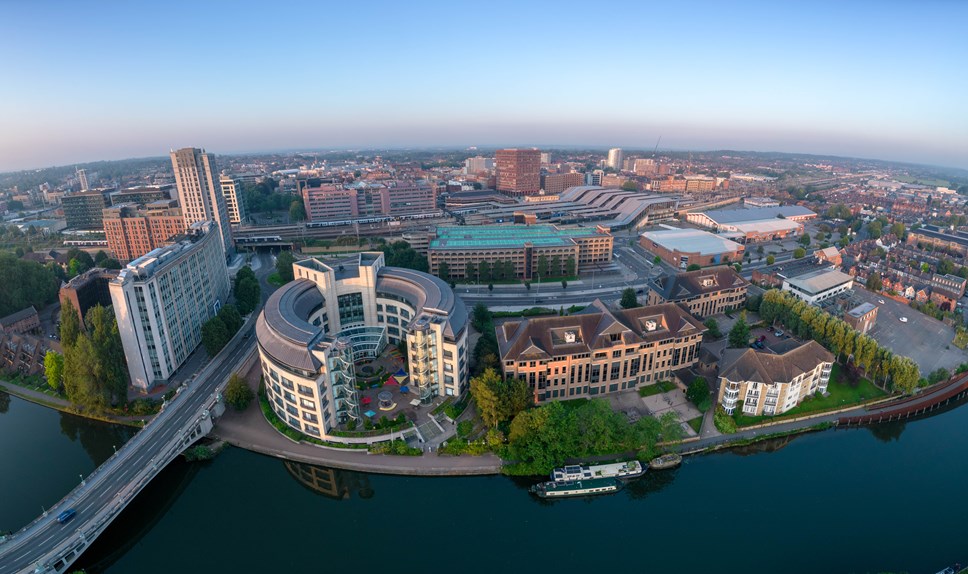
Reading construction is shaped by the Thames Valley technology economy: the Station Hill redevelopment beside the rebuilt station, the Green Park and Thames Valley Park business districts, the Royal Elm Park scheme at the Select Car Leasing Stadium, and a dense M4-corridor pipeline of office, data-centre and logistics work. The mid-tier and SME contractor base is busy across the RG postcodes and into the wider Berkshire commuter belt.
How Reading Construction Sources, Pays, and Reports Its Labour
The Thames Valley office and technology market drives a fit-out and M&E subcontractor economy that is heavier than a town of Reading's size would suggest. Station Hill (the multi-phase mixed-use scheme north of the station), the office stock around Green Park and Thames Valley Park, and the tech-company campuses along the M4 all generate recurring fit-out, refurbishment and services work for Tier 2 subcontractors, most of them limited companies on gross payment status.
The M4 corridor between Reading, Slough and Bracknell is one of the densest data-centre and logistics construction belts in the country. That work is capital-intensive, long-cycle and retention-heavy, with substantial plant and mechanical-services content. Contractors with data-centre exposure carry larger capital allowance positions and longer single-contract retention cycles than typical residential builders.
On the residential side, Reading has a busy small-builder base. Extensions and loft conversions across Caversham, Tilehurst, Earley, Woodley and Lower Earley fund hundreds of sole-trader and micro-company subcontractors. Riverside and town-centre apartment conversion drives a separate fit-out subbie tier that is heavily PAYE-and-CIS mixed.
Sub-postcodes the long-tail queries reach: RG1 town centre and Station Hill, RG2 (Whitley, Green Park) commercial and business-park work, RG4 (Caversham, Emmer Green) residential renovation, RG6 (Earley, Lower Earley) suburban extension work, RG30 (Tilehurst, Southcote) suburban small-builder base, RG5 (Woodley) residential, and out along the M4 to Bracknell (RG12), Wokingham (RG40, RG41) and the Slough data-centre belt.
Services in Reading
Reading Tier 2 subcontractors working the Station Hill programme and the Thames Valley office fit-out market carry steady monthly CIS300 work; the corporate refurbishment cycle keeps filing consistent rather than seasonal.
Read service detailThe Thames Valley pipeline pulls specialist M&E and data-centre subcontractor labour in from across Berkshire and West London. UTR-then-CIS registration handled in sequence usually clears in ten to fourteen working days.
Read service detailSubbies moving between sites in central Reading, Green Park and the M4 data-centre belt regularly clock high work mileage and under-claim it. Four-year backclaims commonly recover 5,000 to 10,000 pounds per subbie once mileage and tools are claimed properly.
Read service detailData-centre and mechanical-services contractors in the Thames Valley often carry substantial plant capital allowance positions; the Annual Investment Allowance at 100 percent on plant up to the limit is the dominant year-end factor for capital-intensive firms.
Read service detailReading firms running mixed PAYE site teams and CIS subcontractors benefit from monthly EPS-side CIS suffered offsetting; the CITB levy threshold is the next pinch-point as the firm scales through 135,000 pounds of in-scope PAYE.
Read service detailCompliance checks on Reading contractors tend to focus on reverse-charge VAT reconciliation across the B2B fit-out supply chain and on verification gaps for specialist subbies coming in from across the Thames Valley.
Read service detailWhat's Different About CIS in Reading
The data-centre and mechanical-services concentration along the M4 means Reading Tier 2 contractors carry larger plant capital allowance positions and longer single-contract retention cycles than typical residential firms. Annual Investment Allowance timing matters, and misjudged capex across a tax-year boundary can move the corporation tax position by tens of thousands.
Reverse-charge VAT applies to most of the B2B fit-out and services work between Thames Valley contractors. The transition trips up subcontractors who grew from direct-to-public residential work into commercial refurbishment: they keep charging VAT when they should be invoicing net with the reverse-charge note, and the reconciliation problem surfaces at year-end.
Station Hill and the larger commercial schemes are multi-phase, so Reading contractors carry retention across programme phases. Proper segregation of retention as a separate debtor line, rather than lumping it into trade debtors, is what makes the year-end accounts reflect the true cash position for a bank or funder reading them.
The Thames Valley technology market occasionally generates R&D-adjacent construction, particularly on data-centre cooling, power resilience and specialist building-services engineering. R&D tax credits can apply where the work is genuinely innovative; the regime tightened from April 2023, but the SME credit remains meaningful for firms doing real novelty rather than standard build-out.
For Reading firms working across the South East, we also cover London (multi-borough subcontractor and Tier 1 supply-chain work), Oxford (life-sciences and university-estate construction), and Brighton (Sussex residential and seafront fit-out).
Construction Accountants inReading: Common Questions
Reading primarily, with regular work across Wokingham, Bracknell, Newbury, Slough and into the western edge of London. We treat the Thames Valley as one construction economy because subcontractor labour and main-contractor rosters move freely along the M4 corridor.
Yes. The M4 data-centre and logistics belt around Reading and Slough is one of the densest in the country, and that work has its own pattern: heavy plant capital allowances, long single-contract retention cycles, and reverse-charge VAT throughout the supply chain. We treat it as its own accounting pattern rather than as general building work.
Common pattern. A Slough, Bracknell or West London firm working a contract in central Reading files its CIS300 from the registered office; the site location does not affect filing. Mileage and accommodation for site teams travelling the corridor become claimable expenses. Filing follows the firm, not the site.
A few. The data-centre and services capex pattern makes the Annual Investment Allowance position more material than in residential-only economies. Reverse-charge VAT density is high because of the B2B contractor concentration. Multi-phase commercial schemes put more weight on retention treatment and stage-of-completion revenue recognition than short residential work does.
Yes. CIS, payroll, VAT and year-end work runs through cloud accounting software and video call, so where the practice sits rarely limits the service. We quote on scope and construction-accounting experience rather than postcode proximity.
Yes. Reading has a healthy small-builder base across Caversham, Tilehurst, Earley and Woodley. Extensions, loft conversions and renovation work fund a busy sole-trader and micro-company subbie market that runs separately from the Thames Valley fit-out and data-centre supply chains.